Juan Preciado and Pedro Páramo: Father and Son
Pedro PáramoJuan Preciado and Pedro Páramo: Father and Son is a bond established through a mother’s account and a son’s belated journey, but never completed in a meeting between them. Pedro is the father Juan is sent to find; his long absence, and the hope Juan builds around him, make the relationship consequential even as death forecloses its promised reunion.
Identity and the Unsettled Family Bond
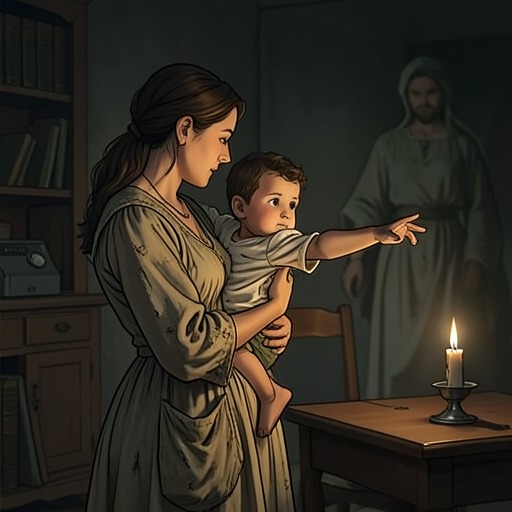
Juan learns that Pedro is his father from his mother, Dolores Preciado. She identifies Pedro as her husband and tells Juan that Pedro lives in Comala. The relationship reaches Juan not through contact with Pedro but through Dolores’s words at the end of her life. It is therefore both a family fact and an inheritance: the news gives Juan a father to seek, while the circumstances of its telling leave him to act without the possibility of asking his mother more.
Dolores asks Juan to go to Pedro after she dies and assures him that Pedro will be glad to know him. At the same time, she tells him not to demand anything beyond what is owed to them. Her account joins the prospect of recognition to a grievance: Pedro had left mother and son forgotten and had not given Dolores what he owed. The son’s search thus begins with two different expectations placed side by side, a possible welcome from his father and a debt owed to his abandoned family.
Juan presses his dying mother’s hands and promises to go. He is willing to promise whatever she asks, and only after her hands have died does he manage to detach his own from them. That physical parting makes the promise more than an abstract instruction: it is made in the immediate presence of Dolores’s death, when Juan cannot refuse her request without also refusing her last appeal. The journey to Pedro begins as an act of filial obligation before it becomes a pursuit of hope.
Promise, Hope, and the Journey to Comala
Juan later admits that he had not intended to keep the promise. Only more recently, as he began to fill himself with dreams and let illusions grow, did he construct a whole world around the hope represented by the man called Pedro Páramo, his mother’s husband. His eventual arrival is therefore not the simple fulfillment of a steady plan. The promise remains dormant until an imagined possibility gives it force again.
The journey carries Dolores’s presence into the relationship. Juan feels that he sees Comala through her memories, nostalgia, and sighs. She had longed for the return to Comala but had never gone back; Juan comes in her place, bringing with him the eyes through which she had looked at the place. Her remembered description of the valley and the town shapes the destination before he sees it for himself. In this way, the father Juan seeks is bound to a place that reaches him first as his mother’s memory.
The road itself expresses the divided positions of departure and arrival: it rises for the person leaving and descends for the one coming in. Juan arrives during the burning August heat, but the physical journey does not bring him closer to a living father. When a fellow traveler asks what he will do in Comala, Juan answers that he will see his father. His plain answer gives the quest its central purpose, even as the silence that follows leaves its outcome unstated.
A Claimed Kinship and an Absent Father
On the way, another man tells Juan that he, too, is a son of Pedro Páramo. The disclosure briefly makes Juan’s search part of a wider pattern of claimed descent: Pedro is not presented only as the father Juan has been sent to find, but as a father whose children may encounter one another on the road. The evidence does not establish a meeting between Juan and Pedro, or explain what either son knows of the other beyond this exchange. The other man’s claim sharpens the contrast between biological connection and actual relationship: being Pedro’s son does not itself provide access to Pedro.
When Juan reaches the question of what happened to the village, he is told that no one lives there. He asks specifically about Pedro and learns that Pedro has been dead for years. The answer overturns the premise of the journey. Dolores had sent Juan to find a father she described as living in Comala; Juan’s hope had revived the promise; but the destination contains no living father to receive him. Pedro’s death is not a reunion delayed by circumstance. It makes the promised encounter impossible before Juan can reach him.
The Relationship After Pedro’s Death
After Juan has died, he explains that he came to see Pedro, who would apparently be his father, and that illusions guided him. The retrospective admission gives the journey a painful double meaning. Juan did fulfill his mother’s request in the literal sense of going to Comala, but he arrived too late to see Pedro alive. The hope that carried him forward had offered a future relationship; after Pedro’s death, it can only be recognized as an illusion that brought Juan to a place where the father he sought was absent.
The relationship therefore ends without an exchange between father and son. Juan receives his knowledge of Pedro from Dolores, carries her memories toward Comala, and reaches only the news of Pedro’s death. His later explanation preserves the difference between the father as a family fact and the father as an imagined possibility: Pedro is indeed the man Juan came to seek, but the expected recognition never occurs. What remains is the cost of an inherited promise, made intimate by a dying mother and sustained by a son’s hopes, but left unanswered by the father’s absence.